
ORCL earnings date: Put December 14 Down in Pencil
December 14 is the best estimate for Oracle’s Q2 FY2027 report, but the company has not confirmed the date or…

The short version
- December 14, 2026, is the estimated ORCL earnings date, but Oracle has not formally confirmed it.
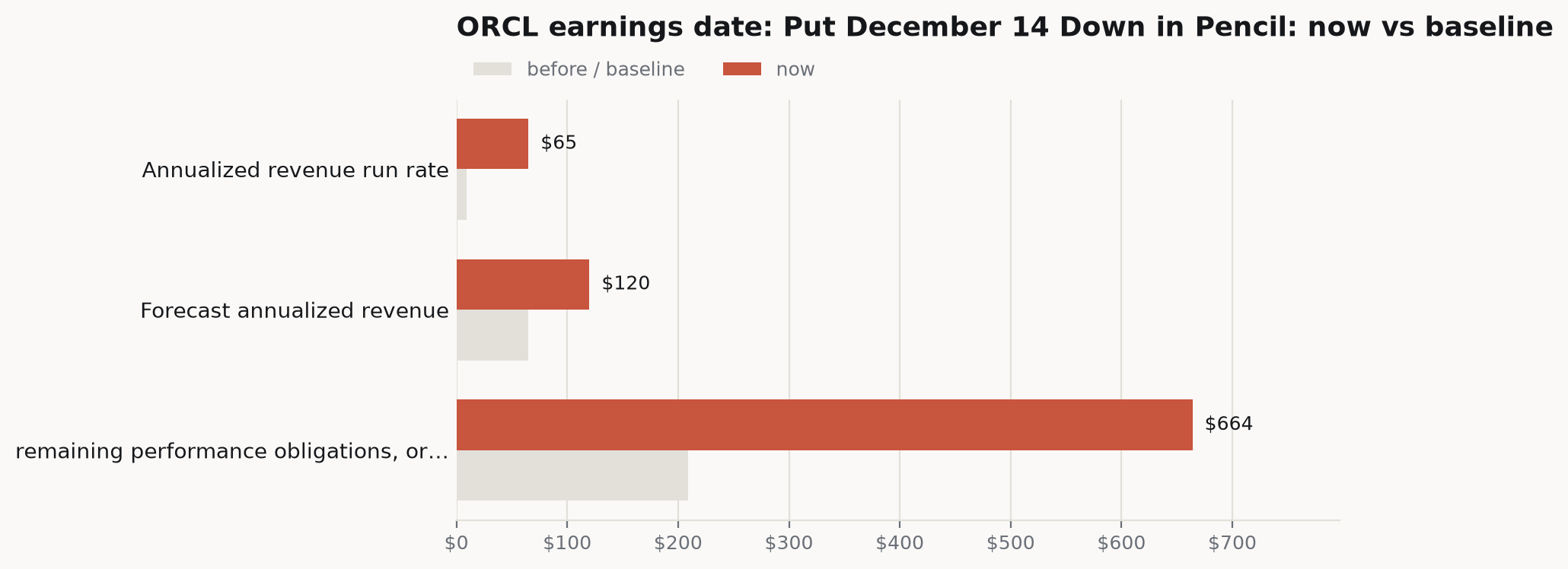
- Oracle guided Q2 FY2027 revenue growth of 30% to 34% while carrying $664 billion in remaining performance obligations.
- Investors should watch whether contracted demand becomes usable cloud capacity and eventually produces durable free cash flow.
Circle December 14 in pencil. Anyone calling it the confirmed ORCL earnings date is getting ahead of Oracle, which has yet to put the event on its Investor Relations calendar.
The expected event is Oracle’s Q2 FY2027 report. The date comes from a third-party financial calendar, while Oracle’s latest earnings release provides guidance for the coming quarter without scheduling the announcement. My calendar entry says “EXPECTED” in aggressive capital letters.
I won’t build a trading plan around that day until Oracle publishes a release or webcast notice. In Italian terms, I asked for the table; the restaurant has yet to answer on WhatsApp.
Last checked: September 27, 2026.
When the December 14 ORCL earnings date becomes official
The Buildout’s Oracle company page lists December 14 as the expected date for Q2 results, following Oracle’s previous release on September 10. Oracle’s first-quarter announcement leaves the next date open. Finance sites tend to blur “expected” and “confirmed” because a clean date looks better in search results than “Larry’s calendar people haven’t told us yet.” For now, the date is useful for setting an alert and useless as a promise.
Clausebench said:
A later date is more time to do the same amount of work, not less work.
Here’s how an estimate acquires fake authority. A financial-data provider studies Oracle’s fiscal calendar and recent reporting cadence, then chooses the most likely day inside the usual window. Other websites import that day through shared feeds, so one forecast appears across a dozen calendars. Google sees agreement, investors set alerts and the date begins to feel official even though the underlying evidence hasn’t changed. Oracle ends this little game by publishing an earnings announcement or webcast listing through Investor Relations. That first-party notice makes someone accountable for the schedule.
I verify the release timing and call details separately because a confirmed date still leaves practical questions. Results may arrive before the market opens or after it closes, while the webcast can have its own start time. Those details matter if I’m holding short-dated options. They matter considerably less if my plan involves coffee, breakfast and reading the release the next morning like a person who enjoys normal blood pressure.
My system is boring on purpose. I create one alert for the estimated day, replace it when Oracle publishes the event and check Investor Relations again on the morning of the report. Founder life taught me this after enough calls from airport lounges where “Central” and “Eastern” became surprisingly expensive philosophical concepts. Previous events reveal Oracle’s habits, but a habit carries less weight than a fresh announcement.
There’s also a source-quality issue hiding in plain sight. Oracle controls the event, so its newsroom and Investor Relations page deserve priority over an automated calendar, however respectable that calendar looks. A provider can make a perfectly reasonable estimate and still miss a last-minute scheduling change. Earnings pages rarely advertise that distinction with the enthusiasm it deserves because uncertainty is terrible for clicks.
EDPB Deputy Chair Jelena Virant Burnik said:
The new EDPB guidelines are a major step in further aligning how Data Protection Authorities decide whether an administrative fine should be imposed, either on its own or alongside other corrective measures. The GDPR significantly increased the corrective powers of DPAs, with fines serving as an important instrument for effective enforcement. The guidelines reaffirm our commitment to providing greater clarity and ensuring the consistent application of the GDPR across Europe.
December 14 remains the best available estimate. Nobody outside Oracle knows when the company will formally confirm it. Ten websites repeating one date can still be a single forecast wearing ten different blazers.
Why Oracle calls it Q2 FY2027
The fiscal label looks wrong because the report is expected during calendar year 2026. Oracle calls it Q2 FY2027 because its fiscal year ends on May 31, and the year in the label refers to when that accounting year finishes. The December quarter sits inside the fiscal year ending the following May. No wormhole required, sadly.
The release comes after the quarter because Oracle first has to close the reporting period. The company consolidates results across the business and prepares its disclosures once the underlying activity has been measured. Management settles the guidance language while the legal team checks what can safely appear in the release. That work takes place after the books close. A mid-December announcement fits Oracle’s fiscal sequence and historical cadence. The sequence supports the estimate, though it cannot prove the exact day.
Oracle announced Q1 FY2027 results on September 10. That completed event gives calendar providers a recent reference point, although one quarter cannot guarantee the timing of the next. Holidays can interfere, internal closing work can drag, and disclosure coordination has its own mysterious weather system. Anyone who has waited for four people to approve a two-line company announcement knows the vibe.
The fiscal label matters when I compare performance too. Q2 FY2027 belongs beside the same fiscal quarter from the prior year because both occupy equivalent points in Oracle’s business cycle. Mixing fiscal and calendar periods can create a trend with all the nutritional value of airport tiramisù.
I learned this through the traditional founder method: making the mistake myself. I once dropped a fiscal-quarter result into a calendar-year spreadsheet, watched the annual curve jump like a meme coin and spent twenty minutes blaming the data provider. The provider was innocent. My spreadsheet had chosen violence.

Image alt text: Expected ORCL earnings date and Oracle fiscal 2027 calendar.
Now I write the fiscal quarter beside the expected announcement month in every note. That tiny habit saves me from opening a spreadsheet six months later and wondering whether “Q2 2027” came from Oracle’s accounting calendar or a sleep-deprived version of me at an airport bar.
The backlog has to become usable cloud capacity
Oracle guided total revenue to grow 30% to 34% in Q2 compared with the prior-year quarter. That range will dominate the headlines. I care more about the machinery underneath because Oracle can sign a spectacular AI-cloud contract months before the related service appears as revenue.
The chain begins with the contract. Its committed value enters remaining performance obligations, or RPO, before Oracle delivers the associated computing service. Oracle then needs data-center space, power and GPUs that customers can use. Once that capacity comes online, customers run training or inference workloads and Oracle recognizes cloud-infrastructure revenue from the delivered service. The company says customers are also migrating from on-premises software into Oracle’s cloud, which shifts revenue between those businesses. Oracle funds much of the capacity build before the corresponding cloud revenue arrives. That timing gap allows a giant backlog and ugly free cash flow to occupy the same earnings release.
Oracle ended the first quarter with $664 billion in RPO, which was $209 billion higher than a year earlier. I read that balance as contracted future business carrying an equally huge delivery obligation. Revenue recognition waits for Oracle to provide the service, and a signed contract cannot cool a GPU rack.
The customer mix behind that balance remains a mystery from the outside. Oracle hasn’t disclosed who accounts for the full backlog, how concentrated those commitments are or the detailed payment terms. A broad customer base has a very different risk profile from a few AI labs ordering compute by the aircraft carrier. Until Oracle provides more detail, nobody can honestly quantify that concentration risk.
Execution has already produced serious growth. Oracle reported $19.3 billion in quarterly revenue, up 30% from the prior-year period. That tells me the capacity build is translating into reported business, even if the backlog remains vastly larger than current quarterly revenue.
Cloud-infrastructure revenue reached $7.4 billion, an increase of 121% from the same period a year earlier. Software revenue declined as customers continued moving from on-premises products into cloud services. One business loses some familiar revenue while the physical cloud operation has to absorb the migrating demand.
That mix shift has a physical cost. Traditional software does not require Oracle to build another GPU-packed data hall whenever a customer expands usage. Cloud infrastructure does, complete with cooling hardware and an electricity appetite that would terrify my Italian grandmother.
Oracle finance chief Hilary Barbara Maxson said gross margin declined as the company ramped its data centers and accelerated infrastructure revenue. I expect pressure during a capacity sprint, so the decline itself does not shock me. The December release still needs to show that signed contracts are moving toward delivered compute instead of waiting in RPO purgatory.
Capacity arriving on schedule gives Oracle something billable. Delays push revenue farther out while spending continues, which is why contract conversion matters more to me than another victory lap around the backlog number.
Free cash flow is where the AI bill arrives
Oracle generated $23 billion of operating cash flow in the first quarter while free cash flow came in at negative $5 billion. The company attributed the gap to investment supporting cloud-infrastructure growth. This is the financial version of taking restaurant reservations for six months and then remembering that ovens cost money.
The sequence starts when AI-cloud demand outruns Oracle’s available supply. Oracle signs additional contracts, and some customers may provide cash before receiving the full service. The company spends heavily on data centers and equipment so those commitments can become usable capacity. Advance payments can lift operating cash flow while capital spending crushes free cash flow in the same period. Revenue arrives later as Oracle delivers the contracted services. Durable economics depend on those receipts eventually covering the complete cost of the buildout.
There is a strong counterargument to celebrating Oracle’s record operating cash flow. R40.io reported that customer prepayments containing a significant financing component accounted for $11.4 billion of it. The cash is genuine and useful, especially when Oracle has massive infrastructure commitments. Oracle also owes future compute to the customers who supplied it, so I’m careful about treating every dollar as proof that the existing business suddenly became a cash fountain.
I’ll concede the obvious upside: prepayments can be a smart funding mechanism. Customers want scarce compute, Oracle needs money to build it and both sides get something useful from the arrangement. The unanswered question is how much of the backlog becomes durable free cash flow after Oracle absorbs capacity costs, power bills, financing and depreciation. Public disclosures still leave too much hidden about customer concentration and payment terms to calculate that cleanly.
Power adds another layer of uncertainty. Oracle says Project Jupiter in New Mexico remains on schedule, directly answering reports of roughly a one-year delay, and Blue Owl says its commitments and financial obligations are unchanged. Nobody outside the project has the final power-delivery schedule or a reliable estimate of any financial consequences. A data center without enough electricity is an unusually expensive lawn ornament.
I expect Oracle’s Q2 revenue headline to look excellent if the company lands inside its guidance. If free cash flow stays deeply negative while RPO climbs again, the market will stop applauding reservations and start asking when dinner actually reaches the table.
Frequently asked questions
When is the next ORCL earnings date?
The expected ORCL earnings date is December 14, 2026, for Oracle’s Q2 FY2027 report. Oracle has not confirmed the event on its Investor Relations calendar, so the date remains an estimate from a third-party financial calendar until Oracle publishes an earnings announcement or webcast notice.
Why is Oracle reporting Q2 FY2027 in December 2026?
Oracle calls the expected December report Q2 FY2027 because its fiscal year ends on May 31. The label uses the year in which the accounting year finishes, so a quarter reported during calendar 2026 can belong to the fiscal year ending in 2027.
What should investors watch in Oracle’s Q2 FY2027 earnings?
Oracle guided Q2 revenue growth of 30% to 34%, but the key issue is converting $664 billion in remaining performance obligations into delivered cloud capacity. Investors should also watch gross margin and free cash flow as Oracle spends on data centers, power and GPUs before related revenue arrives.
Sources
- Oracle Announces Q1 Results Driven by Triple Digit Growth in Cloud Infrastructure Revenues
- Form 8-K, Results of Operations and Financial Condition
- Oracle Corporation Q1 FY2027 Form 10-Q
- Oracle Corporation (ORCL) Q1 2027 Earnings Call Transcript
- Oracle posts strong sales growth and negative free cash flow
- ORCL Q1 FY2027 reported earnings analysis