
Azure customers cannot rent Maia, but Copilot already runs on it
Maia 200 is already serving Microsoft workloads, but Maia 300’s efficiency claims and multi-gigawatt…

The short version
- Microsoft’s Maia 200 already serves Copilot, while Maia 300 production deployments and multi-gigawatt expansion are planned for 2027.
- Microsoft projects 40% more tokens per megawatt than unnamed GPU systems, but independent matched testing remains unavailable.
- Maia could lower Microsoft’s internal inference costs and Nvidia dependence before Azure customers gain direct access to the hardware.
Microsoft says Maia 300 will produce 40% more tokens per megawatt than unnamed leading GPU systems. Nobody outside Microsoft can test that claim, Azure customers cannot rent the chip, and Microsoft gets the first discount.
Every Copilot answer, coding suggestion and agent retry adds an inference bill. Owning the machinery gives Microsoft more control over power and capacity while keeping money that would otherwise go to Nvidia.
Anthropic described the growing code-review bottleneck:
Coding agents keep increasing the pace at which teams write code, and the review bottleneck hasn't eased.
The Claude Code team explained its approach to code review:
We didn't remove review. But we did move most of the reading to machines, optimized for human time and attention, and invested heavily in making it fast and easy to undo mistakes.
Today’s Maia serves Microsoft workloads. Its successor enters production in 2027, when Microsoft plans to scale the family from today’s footprint to multi-gigawatt deployments. Nobody reserves that much electricity for decorative silicon.
I keep coming back to the rack. It contains the strategy in one terrifying object: Microsoft chips on Microsoft networking, drawing enough power to make a utility executive reach for the grappa.
production scars beat benchmark trophies
Running Maia in production gives its successor what every chip announcement wants: production scars. Microsoft says Maia already serves Copilot and supports the internal MAI model team; GitHub Copilot and Microsoft Foundry will follow. Real traffic exposes what demos hide: prompts vary wildly, jobs fail halfway, demand spikes after launches, and accelerators sit idle when memory cannot feed them. Microsoft says those lessons shaped the successor. Engineers have seen cloud inference break at three in the morning, while model teams have learned the cost of escaping GPU-built infrastructure. That reduces execution risk, though performance remains unproven until the new silicon handles production traffic at scale.
The feedback loop is direct. Microsoft watches Copilot requests to find where long prompts stall or token generation waits for data. Engineers trace kernels moving too many bytes, then adjust memory and scheduling. Operations teams see utilization collapse under uneven requests. Model developers learn which optimizations survive customers and which only looked clever in benchmarks. Those lessons shape the next chip, its compiler and the surrounding rack. Fresh silicon can still fail spectacularly, especially when advanced packaging, powered datacenter space or HBM supply gets tight.
I initially underestimated this production lineage. A benchmark champion can look fabulous in a lab until Tuesday morning, when a million people ask Copilot to summarize the same earnings report.
The roadmap becomes much bigger in 2027. Microsoft plans to deploy Maia 300 and scale the family to multi-gigawatt capacity, making Maia its primary inference system for Microsoft products and services. “Primary” is doing cardio in that sentence. Microsoft has disclosed neither Maia’s traffic share nor a regional rollout, and nothing about customer-accessible capacity.
That matters. AWS customers can access Trainium. Google Cloud customers can use TPUs. Microsoft currently wants Maia where Microsoft pays the token bill.
Maia 300 wants every byte nearby
Microsoft identifies data movement as a growing constraint in large inference systems, so Maia 300 keeps each byte near the work needing it. Software-defined dataflow places computation near relevant data, while AI-assisted kernel optimization arranges that work for each model. Specialized kernels use on-die SRAM as a software-managed scratchpad, avoiding repeated HBM trips. Lower-precision formats shrink computation and the KV cache holding conversation state during generation. A custom Ethernet transport extends this approach across accelerators and racks. Compute stays busy only when software places data correctly. Otherwise, fast memory becomes expensive furniture.
When Copilot answers, the model first processes your prompt during compute-heavy prefill. During decode, it generates tokens one by one, repeatedly reading weights and cached conversation state. Longer contexts enlarge that cache. Agents add tool output, call the model again and extend the working history, increasing the memory burden each lap. Arithmetic units can end up waiting to be fed, the silicon equivalent of an Italian government office in August. Maia tries to reduce that wait by keeping useful data nearby and coordinating system-wide handoffs.
Each accelerator has 18 TB/s of peak HBM bandwidth across eight HBM4 stacks within a 950-watt thermal envelope. Microsoft provides no equivalent predecessor figures in the announcement, so these specifications show available plumbing, not application speedup. Bandwidth helps only if the model, kernels and serving setup can use it.
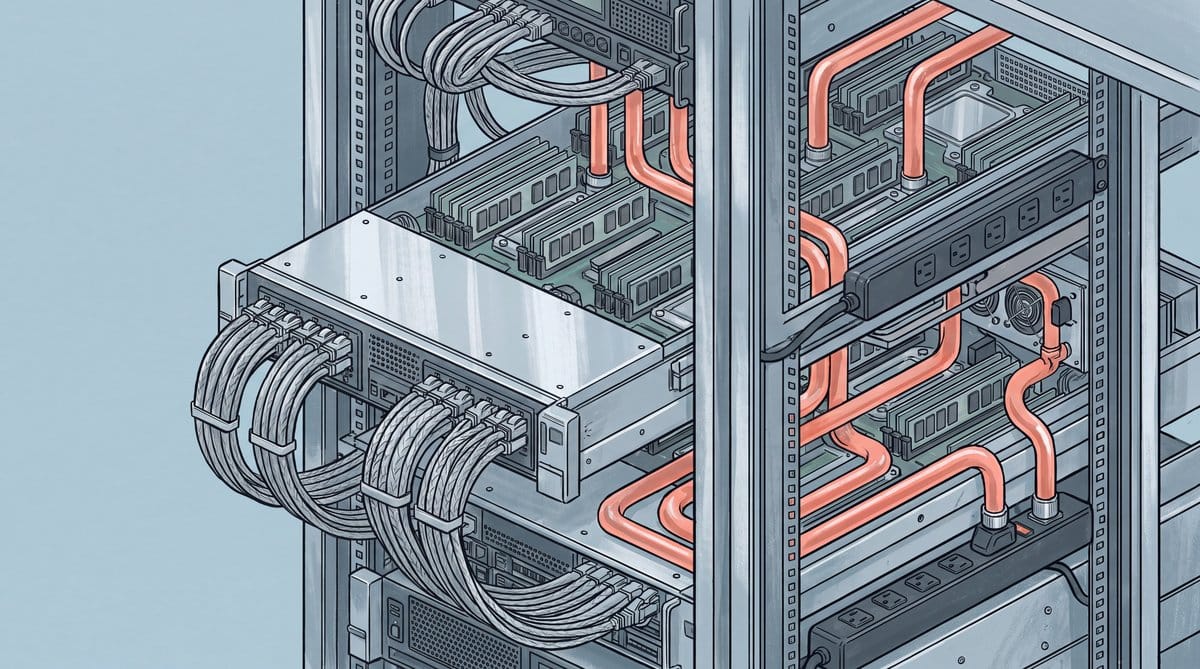
A full Maia 300 rack contains 96 accelerators, twice the comparison rack’s chip count, within a 167-kilowatt power envelope. Microsoft says it can deliver up to seven times Maia 200’s rack-scale token throughput. “Rack-scale” earns its salary: the result combines more accelerators with gains from each chip, networking and utilization. Microsoft has not published matched tests separating those contributions.
As an Italian, I appreciate a fast machine. Twice as many engines in the garage do not make each Ferrari twice as fast, though they make the electricity bill unforgettable.
the efficiency claim needs receipts
The 40% projection compares expected Maia 300 tokens per megawatt with “leading GPU-based systems.” Power is the right hyperscaler metric because a constrained grid connection limits datacenter inference. But the unnamed baseline makes the headline impossible to assess.
Microsoft has not identified the GPU system, model or serving configuration. We do not know the precision, context length, batch size or latency target. Nor did Microsoft define the power boundary: accelerator draw gives one result; the whole rack or facility gives another. Aggressive batching can raise aggregate throughput while leaving each Copilot user staring at a spinner. A useful benchmark would hold model quality and workload constant, then publish output beside latency. Independent Maia 300 tests under matched service conditions do not yet exist.
The rack claim needs equal discipline. Total output and per-accelerator speed answer different questions. A larger rack can win with more chips; better networking can improve utilization without changing arithmetic capability. Both matter at Microsoft’s scale. Calling this a sevenfold chip speedup would be marketing fan fiction.
Microsoft’s custom hardware has shown some production-efficiency evidence. For built-in experiences including Teams and Copilot, Microsoft reported up to 1.7 times the tokens per watt of leading GPU infrastructure. Microsoft calls that an upper-bound result and again leaves the GPU baseline unnamed. Promising, yes. Reproducible, no.
Microsoft has also balanced Maia 300 for expected workloads: long contexts need more memory, decode-heavy services repeatedly fetch model state, and cloud deployment caps power. Maia 200 showed Microsoft where those constraints hurt in production, pushing the new design toward greater data locality and software-managed memory. Custom transport extends that logic beyond one accelerator, letting compute and memory across the rack act as one system. Microsoft plans multi-gigawatt deployments because it wants Maia as the default inference machinery behind its products. The logic holds, even if the performance claims still need independent proof.
Much remains unknown. Microsoft has not shown it can secure and deploy the hardware at the promised scale and schedule. Nobody outside Microsoft knows which models will run there, how much inference Maia will carry, or whether Azure customers will ever rent it directly. My question is brutally simple: how many Copilot requests will land on these chips?
Microsoft gets the first discount
Most users will never select Maia from a dropdown. They will ask Copilot something, trigger an agent or start a coding task, and Microsoft will choose the accelerator behind the curtain. That freedom drives the economics.
If Maia generates more acceptable responses within the same power budget, Microsoft can serve more users before securing another grid connection. It can reserve scarce Nvidia systems for training and customer workloads needing general-purpose GPUs. A lower internal cost per Copilot response compounds across tool calls, retries and long agent sessions. Microsoft can use the gain for faster responses, larger limits or fewer capacity errors, or keep it as gross margin. Silicon creates the option. Competition decides who gets the savings.
I have watched infrastructure savings vanish into budgets before customers saw one cent. When my hosting bill dropped, I was not possessed by consumer generosity. I used the headroom for growth, reliability and delaying the next painful capacity purchase. Cloud companies do the same, only with better catering.
Microsoft has published no matched dollars-per-token comparison and promised no Copilot or Foundry price reduction. Maia also remains unavailable as a normal customer-rentable Azure instance. Outside teams cannot capture its efficiency directly, even if every projection is right.
The benefit may first appear as more capacity, faster responses or fewer limits. I would watch provisioned-throughput pricing and agent metering rather than wait for “Maia” on an Azure invoice.
Nvidia will remain embedded in Azure because Microsoft still needs general-purpose GPUs for training, customer rentals and workloads unsuited to Maia. AI demand can increase Nvidia purchases while Maia takes more internal Microsoft traffic. Hyperscaler dependency fades one purchase order at a time.
By the end of 2027, I expect Maia to carry meaningful Copilot traffic while remaining unavailable as a standard Azure instance. Microsoft will talk loudly about capacity and quietly about pricing. If Copilot limits improve while prices stay put, Maia worked perfectly for its first and most important customer: Microsoft.
Frequently asked questions
Is Microsoft Azure Maia already running in production?
Azure Maia 200 is already serving production Microsoft workloads, including Copilot and the internal MAI model team. Microsoft says GitHub Copilot and Microsoft Foundry will follow. Maia 300 is not yet deployed in production; Microsoft plans production deployments and multi-gigawatt expansion beginning in 2027.
How much more efficient will Microsoft Maia 300 be than GPU systems?
Microsoft projects that Maia 300 will produce 40% more tokens per megawatt than unnamed leading GPU-based systems. The company has not disclosed the comparison hardware, model, precision, context length, latency target or power boundary, and independent matched tests of Maia 300 do not yet exist.
Can Azure customers rent Maia accelerators directly?
Azure customers cannot currently rent Maia as a standard accelerator instance. Microsoft is using Maia for its own products and services, where it pays the inference bill. Customers may experience indirect benefits through greater capacity, faster responses or fewer limits, but Microsoft has promised no corresponding price reduction.
Sources
- Microsoft to expand Azure Maia system to multi-gigawatt deployments
- Deep dive into Azure Maia 300 architecture
- Microsoft plans huge deployment of its own AI chips, with an eye on saving costs
- Microsoft, Big Tech challenge Nvidia with move to custom silicon
- Microsoft’s “Clea” Maia 300 Inference XPU Is A Bandwidth Beast
- Microsoft plans multi-gigawatt rollout of next-gen Azure Maia AI accelerator racks