
Extreme heat sends Italian vineyards to work at 4 a.m.
Floodlights, frantic crews and 24 daily press runs keep Franciacorta fresh as a historic July harvest scrambles Italy’s wine calendar.
At 4 a.m. in Franciacorta, floodlights blaze across Berlucchi’s vineyards while workers clip Pinot Nero into crates. Most of Italy is asleep, or posting suspiciously perfect Puglia photos from the previous afternoon. Extreme heat now forces Italian vineyards into pre-dawn harvests. In late July, Berlucchi expected to start August 10. Then sugar climbed, acidity slipped, and the winery had roughly two days to summon workers and ready the presses.
A vineyard offers no rollback. I can patch software. I cannot roll back a Chardonnay grape.
Inside the winery, this climate headline becomes an emergency protocol of floodlights, temperature checks, cooling equipment and people reorganizing their lives before sunrise. If the Franciacorta tastes beautifully fresh, the weather deserves zero credit. Familiarity in the glass required hard, early work under abnormal conditions.
The vineyard calendar has entered its chaos era
In Ivrea, vendemmia meant September: school restarting, village festivals and adults pretending several hours of agricultural labor justified a lunch capable of sedating a small horse.
August belonged to Ferragosto. July belonged to arguments about beach umbrellas.
While summer was still “in full swing,” La Repubblica’s Il Gusto reported the sound of harvest shears. Grapes entered western Sicilian cellars before July ended. Oltrepò Pavese followed, then Franciacorta.
Berlucchi began harvesting August 2, according to AP News: around 10 days earlier than the previous year and approximately one month earlier than three decades ago.
Some Franciacorta vineyards started in July for the first time in 20 years, Il Giorno reported. Castello Bonomi in Coccaglio scheduled its opening harvest for July 31, while many neighbors prepared to send crews into the rows at dawn on August 3.
Moving harvest means immediately finding crews, drivers and crates. Presses need cleaning, and the cellar must receive fruit as fast as the vineyard releases it. Any mismatch creates a bottleneck while grapes keep warming and ripening.
Even in July’s final days, Berlucchi expected to begin August 10. Pinot Nero sugar readings then accelerated, forcing the winery to mobilize its workforce and presses within about 48 hours.
Arturo Ziliani, Berlucchi’s CEO, told AP News:
We did not expect such an early harvest or such an acceleration in ripening,
Collapsed timelines feel awful, though adrenaline has its appeal. Founders build personalities around fixing impossible problems at 2 a.m. Mildly unhealthy, but great for podcast bios.
Wine growers have less room for this nonsense. One slow response can alter an entire vintage’s raw material.
Ziliani called these “delicate, frantic moments” when everything must work perfectly. Frantic clashes with wine tourism’s linen shirts, slow afternoons and grandfathers inspecting vines with ancestral wisdom.
The old calendar guided seasonal hiring and equipment bookings. In 2026, one parcel’s sugar reading can overrule the plan in two days. The tasting-room calendar keeps losing arguments to field data.
Sparkling wine has a two-day panic button
Heat accelerates ripening. Lovely, until you remember what traditional-method sparkling wine needs.
As grapes mature, sugar generally rises while acidity falls. Greater ripeness can give many still wines richer fruit and more potential alcohol. Franciacorta faces a tighter equation: its base wine must survive secondary fermentation in the bottle without becoming carbonated peach jam.
Traditional-method sparkling wine typically starts with higher fixed acidity, lower pH and less sugar than many still reds or whites. Those numbers create tension in the glass: bright fruit, clean structure and bubbles with some purpose in life.
My nonna would probably object to discussing pH over lunch, but chemistry ignores Italian family etiquette.
Attilio Scienza, professor emeritus at the University of Milan, explained the timing problem to AP News:
Early-ripening varieties such as Chardonnay require great care, because a delay of just a couple of days can leave you with grapes unsuitable for sparkling wine. Sugar rises too quickly and acidity falls too quickly,
A couple of days. That is the entire margin.
Those extra 48 hours can push grapes beyond the style a Franciacorta producer needs. Meanwhile, AP reported weeks of brutal daytime highs: 37–38°C, roughly 99–100°F, with below-average rainfall.
Nights matter equally. Giornale di Brescia reported that hot overnight temperatures reduce the thermal swing vines need to develop acidity and aromatic compounds. Cool nights usually reset plants after daytime heat. In 2026, that reset kept failing.
Simone Frusca of Coldiretti described the mechanics in Giornale di Brescia:
Le temperature elevate - spiega Simone Frusca di Coldiretti - possono accelerare la maturazione delle uve e, se prolungate, incidere sull’equilibrio della pianta. Il caldo sopra i 35 gradi può ridurre l’attività fotosintetica, favorire stress idrico e aumentare il rischio di scottature sui grappoli. A pesare non sono solo le massime diurne, ma anche le notti troppo calde, perché riducono l’escursione termica utile allo sviluppo di aromi, acidità e componenti nobili dell’uva.
In plain English, temperatures above 35°C can slow photosynthesis, increase water stress and scorch grapes. Warm nights also weaken the aromas and acidity sparkling-wine producers race to preserve.
Night harvesting buys cooler fruit and more control. Hot grapes need chilling before gentle pressing, consuming precious time.
Berlucchi ran as many as 24 presses daily, often late into the night, seeking high-quality free-run juice gently extracted from fruit that had raced through maturation.
“Freshness” can sound like wine-critic wallpaper. I taste it as energy: why a second glass of Franciacorta feels sensible, despite considerable evidence from my previous second glasses.
“The quality is fine” is doing heroic work
The soothing line of Italy’s 2026 grape harvest is that the fruit remains healthy. I believe the producers saying it, while listening closely to what follows.
Ferdinando Dell’aquila, Berlucchi’s technical director and oenologist, told AP:
The grapes are perfectly healthy,
Then came the urgency: Berlucchi had to harvest quickly to preserve acidity. Healthy grapes still require an emergency response when their chemistry changes hourly.
Paolo Castelletti of the Italian Wine Union said a good oenologist could manage these conditions without compromising quality. He added that producers need a different organization of work than in previous years.
That second sentence carries an entire vintage on its back.
A healthy grape guarantees neither an easy vintage nor a profitable yield. Hailstorms damaged Franciacorta vineyards and reduced some vines’ fruit load, which can accelerate ripening in the surviving grapes.
Production losses reached around 20% in Berlucchi-linked vineyards, La Repubblica estimated. At Ricci Curbastro in Capriolo, Gualberto Ricci Curbastro told Il Giorno that hail losses were closer to 25%.
Losing a quarter of the crop is savage. The remaining grapes may excel, but the winery makes fewer bottles while absorbing nearly all fixed farming and cellar costs.
The growing season stacked accelerants. A mild winter encouraged early budding. Heat followed, rainfall stayed below average, and damaged vines carried fewer bunches. Sugar concentrated quickly as the harvest window narrowed.
I once heard “quality is not compromised” and assumed climate change had spared the wine. Wrong. It means something simpler: we caught it in time.
Conditions through August and September will shape later-ripening varieties, La Repubblica correctly noted. An early harvest does not automatically make better or worse wine. The bottles will tell us more.
The weather still does not get to take the bow.
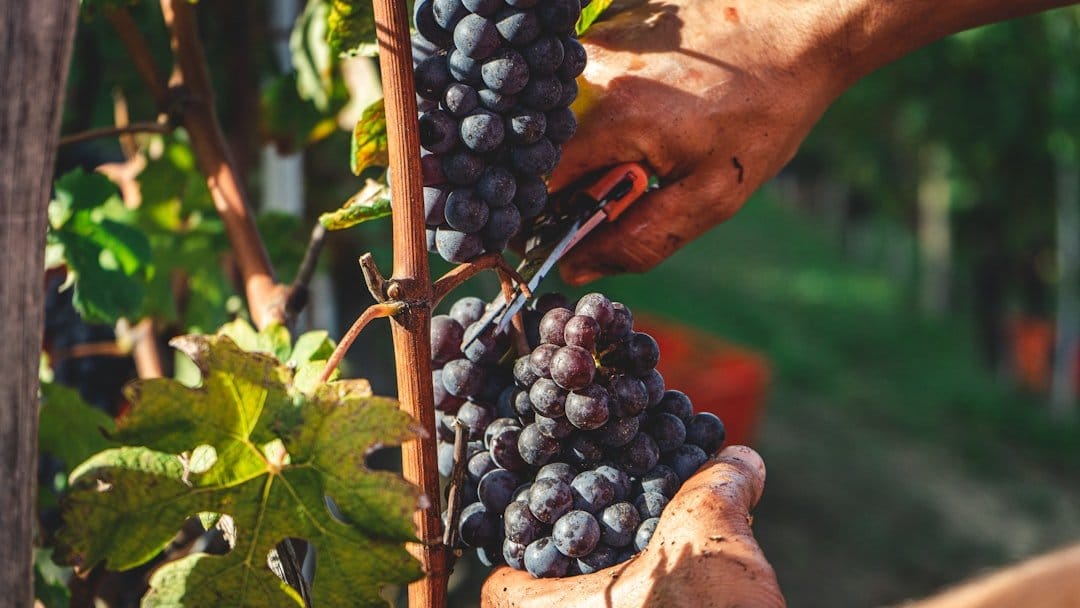
The new face of the Italian vendemmia: workers harvest Franciacorta grapes before sunrise so the fruit can reach the presses before the day’s heat builds. Photo: Antonio Calanni/AP.
Alt text: Workers picking Franciacorta wine grapes under floodlights before dawn during Italy’s early 2026 harvest.
The climate tax arrives on the night shift
At Berlucchi, picking began at 4 a.m. under floodlights. Regional labor rules stopped work during the hottest period, from 12:30 p.m. to 4 p.m. Winemakers told AP the afternoon remained too hot for a practical second shift anyway.
Cooler hours protect grapes and workers. Somebody still pays for the adaptation.
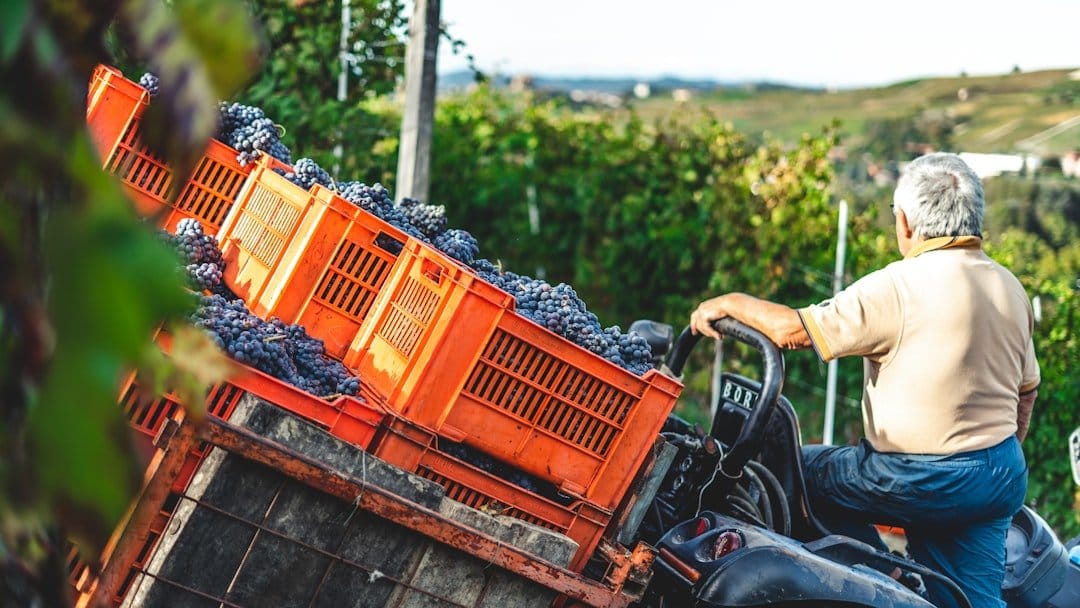
Antonio Calanni’s AP photographs show that invoice in human form. Workers carry crates, unload tractors and cover their heads with towels after sunrise. The restaurant bottle has excellent lighting. Its grapes may have been picked by someone who woke at 3 a.m.
“Night harvesting” sounds like an expensive tasting-menu experience. Reality means broken sleep, portable lighting and transport routes running at strange hours. Fruit reaches the winery in a compressed wave, pressuring the presses while crews are already tired.
A workforce cannot materialize because a refractometer sent an urgent memo. WineNews reported that Italian wineries already struggle to find specialized harvest labor. Sudden date changes make every crew more valuable and every absence more dangerous.
France offers a preview. At Domaine Lafage in the Pyrenees-Orientales, an early harvest arrived while part of the team was on holiday. Jean-Marc Lafage told AFP that marketing, accounting and IT staff were recruited to help.
I cannot stop thinking about the IT team entering the vineyard. Somewhere, a person closed a Jira ticket and received pruning shears. Probably healthier than another sprint retrospective.
Complex products break where systems meet. Wineries have similar pressure points: vineyard measurements trigger labor calls; tractors feed the cellar; cooling capacity determines how quickly presses can work.
A sudden harvest strains every connection at once. Monitoring starts earlier, alerts arrive faster, and presses become a bottleneck. Tomorrow is unavailable as a release date because grapes keep ripening overnight.
Startup culture calls this agility. The unfashionable truth: permanent crunch means the system has a problem.
Pre-dawn lights consume power. Warm grapes require cooling. Presses run late. Managers rebuild staffing schedules while hail losses shrink saleable volume. Water management and worker protections demand more attention.
“Climate surcharge” will never appear beneath Franciacorta on a wine list. Producers already pay it through lost sleep, extra capacity and smaller margins.
Italy’s old harvest sequence is breaking apart
Italy’s grape harvest once followed a recognizable progression. Early southern grapes came first, then northern and high-altitude parcels, while famous red varieties carried the work deep into autumn.
The 2026 sequence makes a wedding seating chart look straightforward.
Sicily officially began July 21 in the Trapanese, according to La Repubblica. Pinot Grigio and other early whites opened a campaign expected to last roughly 100 days, ending around Etna’s higher-elevation vineyards.
That long season suits an island with wildly different exposures and elevations. Stranger were the northern dates, where July shears appeared almost simultaneously.
Oltrepò Pavese began harvesting sparkling-wine grapes close to two weeks before its traditional schedule. Matteo Castellani, head of Coldiretti for Casteggio, told AFP that picking started July 27 and 28 instead of the usual August 10–15 window.
Castellani put it plainly:
This year is historic because the grapes have never been harvested in July before,
Franciacorta produced an even stranger reversal in Ome. Traditionally among the denomination’s final areas to harvest, the town moved forward. In 2026, Rocol di Ome’s owner expected to be among the first and told Il Giorno he had never seen such timing in 35 years.
That bothers me more than a tidy national average. A ten-day advance looks manageable on a chart. Moving from last to first means the local order itself has stopped behaving.
Veneto’s Pinot Grigio, Pinot Nero and Chardonnay were at least one week ahead, ANSA reported. Some wineries considered starting around August 10, especially in younger vineyards and parcels without irrigation.
Giorgio Polegato, president of Coldiretti Veneto’s wine consultation body, stressed the precision required:
L'anticipo della vendemmia - commenta Giorgio Polegato, presidente della Consulta Vitivinicola di Coldiretti Veneto - è il risultato di un andamento stagionale che ha accelerato il ciclo vegetativo della vite, ma non desta particolari preoccupazioni. Le uve sono sane e presentano un ottimo potenziale qualitativo. Sarà fondamentale gestire la raccolta con precisione, vigneto per vigneto, perché la maturazione non è uniforme e richiederà un'attenta programmazione
Veneto has more than 104,000 hectares under vine. Managing it “vineyard by vineyard” demands an absurd amount of observation and coordination.
Tuscany adds another domino. Coldiretti suggested Sangiovese harvesting could begin around mid-August in some areas, although the variety is traditionally associated with a September-to-November window.
One parcel may lose acidity while another remains days from readiness. A storm can hit one slope and spare the next. A single Italian harvest calendar is nearly useless.
Seasonal menus, temporary labor and cellar tourism grew around the old sequence. Families planned around it too. When a town’s harvest festival stays in October but its grapes left the vine in July, the celebration feels like a reenactment.
Resilience comes with an expensive renewal
Berlucchi produces around 4 million bottles yearly, roughly 20% of Franciacorta’s total annual output of 20 million bottles.
At that scale, a producer can mobilize crews, run up to 24 presses daily, cool fruit quickly and distribute work across a substantial cellar. A small family estate may have one press and far less tolerance for equipment trouble or missing workers.
Italian wine entered the 2026 harvest with plenty of business pressure already in the cellar.
Italy has about 241,000 wine businesses generating around €14 billion, according to Coldiretti figures reported by WineNews. Producers also face rising costs, bureaucracy and shortages of qualified harvest workers.
Exports fell 7% in value during 2026’s first four months. In the United States, my adopted market, the decline reached 15% as tariffs met weaker demand. Che disastro.
Between Torino and Los Angeles, I have watched American restaurant and bottle-shop buyers become more cautious. A $40 bottle fights harder for attention than a few years ago, while its Italian producer pays more to protect the harvest.
Inventory adds another unpleasant layer. Giornale di Brescia cited Italian Wine Union analysis showing 46.6 million hectoliters of wine in Italian cellars at midyear, excluding must. That was 6.7% higher than a year earlier and equivalent to around 6.2 billion bottles.
Imagine paying more to rescue a crop while billions of existing bottles await buyers.
Bold.
Growers have options. Earlier monitoring can catch rapid sugar changes. Better canopy management can prevent sunburn. Soils with more organic matter retain water more effectively, and some producers are studying cooler, higher-elevation sites.
Jean-Marc Lafage told AFP that his French estate is testing compost approaches to improve soil water storage. He described growers as becoming “more water farmers than vine growers,” which should make sellers of romantic vineyard posters slightly uncomfortable.
Competent people adapt when reality exposes a weak assumption.
Every fix consumes money or operating capacity. Earlier data collection needs staff and tools. Cooling uses energy. Higher vineyards require suitable land, while changes within protected appellations may need regulatory approval.
Large estates can buy redundancy. Smaller producers often fill gaps with their bodies, families and longer hours. That strategy has a hard limit.
My dated bet: by the 2028 harvest, pre-dawn picking and parcel-level maturity alerts will be routine across Italy’s major sparkling-wine regions. Refrigerated fruit handling will become baseline equipment for more producers, even if nobody mentions it during the cellar tour.
The bottle will still arrive cold, bright and slightly dangerous around the second pour. I have no intention of serving it with a sad climate lecture; Italians have suffered enough.
But when Franciacorta tastes timeless, I will picture the floodlights in Corte Franca. Somewhere, at 4 a.m., somebody is already racing the sun.
Frequently asked questions
Why are Italian vineyards harvesting grapes before dawn?
Italian vineyards harvest before dawn because cooler hours protect workers and keep grapes from arriving hot at the winery. In Franciacorta, extreme heat accelerated sugar accumulation and acidity loss, while night picking bought producers more control and reduced the chilling required before gentle pressing.
How early did the 2026 Franciacorta harvest begin?
Some Franciacorta producers began harvesting in late July or early August 2026. Berlucchi started on August 2, around 10 days earlier than the previous year and approximately one month earlier than three decades ago, after Pinot Nero ripening accelerated and forced the winery to mobilize within about 48 hours.
How does extreme heat affect sparkling-wine grapes?
Extreme heat raises grape sugar and lowers acidity faster, narrowing the picking window for traditional-method sparkling wine. Chardonnay can become unsuitable after a delay of only a couple of days. Producers preserve freshness by monitoring parcels closely, harvesting quickly, picking during cooler hours and chilling fruit before gentle pressing.
Sources
- Primary trending article
- Photos show Italian winemakers harvesting grapes earlier due to extreme heat
- Vendemmia anticipata 2026: date, cause e conseguenze del caldo sulle uve italiane
- Franciacorta, la vendemmia inizia a fine luglio: è la prima volta negli ultimi vent’anni
- Prende corpo la vendemmia 2026 in Italia, tra le più precoci di sempre: l’analisi Coldiretti
- In Veneto vendemmia anticipata a Ferragosto per le varietà precoci